Design Strategy for a Premium Juice Bar
This case study takes ~20 minutes to read. If you’d like something shorter, use the link below to access a 17-slide presentation deck.
Executive Summary
Consulted with a premium health-focused juice store based in Toronto to audit their current practices and explore possibilities to increase profits, lower operational costs, and reduce customer churn. We leveraged the Strategy Process Map and the Strategy Choice Cascade to facilitate the engagement. Through these 2 frameworks, we reframed their problem into a strategic question and generated 3 possibilities. For each possibility, we identified conditions that would have to be true to make that strategy work, honed in on uncertain barriers, and developed tests to examine those barriers. After receiving test results, we analyzed the data and selected a strategy.
Deliverables included Choice Cascades that lay out existing and potential strategic possibilities, along with conditions, barriers, and test results showing the pros and cons of each possibility.
Role and Context: Solo design strategist in the context of a course with IDEO. This is a mock project based on a real-world company. The company name has been changed.
The Brief
Juice the Day (JtD) is a high-end health-focused Canadian juice bar business with locations in Toronto. They have three profitable brick-and-mortar locations, but lately, growth has declined from an all time high of 20% revenue growth year over year in 2020 to 2% revenue in 2022 Founders are now searching for a new strategy to increase profits and lower operational costs.
Key Outcome
Our goal was to guide the founders through two design frameworks (authored by Roger Martin) to create the best strategic plan for them to accomplish their business goals.
Background
Juice the Day: JtD was founded in 2014 by two friends in Toronto who shared a love for their local neighborhood and for healthy, organic food and drinks. They wanted to build a business that would be good for their local community. Their first location was in a mixed-use building on King Street West with storefronts and apartments occupied by young professionals. They have since added two locations: one in another trendy neighborhood, and the other in an underground shopping mall in the financial district.
Their juices can be picked-up or delivered, sold individually or in a packaged bundle. They come in attractive glass bottles that can be recycled or returned to the store for a deposit. The juices cost an average price of $7, nearly double the price of the national brand juices and smoothies found at a local grocery store.
The Problem/Objective
Until now, JtD has won on the basis of product quality (fresh ingredients, local sourcing, innovative recipes and top-notch customer service.) This combination has driven customer loyalty over time.
JtD’s biggest expenses are rent, labor,and ingredients. The owners have spent a lot of time focused on space and location planning, talent acquisition and retention, and sourcing. But today, they spend most of their time developing new recipes, with some time spent on marketing and sales geared towards reaching existing customers.
Lately, growth has been slow. Three years ago, revenue growth hit a high of 20%, but since then, growth has steadily declined. Last year, the business grew at 2%. All the while, profit margins have remained healthy.
The owners are worried about some outside factors. Profits are threatened by increased competition in the juice bar space, an expensive real estate market, and the rising cost of rent.
The company doesn’t have significant cash reserves, but the owners will consider bank loans for any investments they think are necessary.
Users: Mainly young professionals. 35% of them are vegetarian or vegan. 50% buy at least one juice per week, 15% buy one juice per day. Some use it as a meal substitution, or as a nutritional boost. They value Juice the Day for their local/organic sourcing, taste, quality, and convenient location.
Though the company’s most loyal customers love them, there is a lot of churn in the company’s overall customer base, and a good number of customers purchase less than once per month.
Competition: There’s a dozen other small players with local neighborhood footprints targeting the premium market. There’s 2 national franchises in the area with mass-produced lower-cost products, and there’s several health-focused grocery stores that sell fresh and pre-packaged juices. The national brands are the leaders, but the niche businesses have higher margins and higher frequency of purchase per customer
Overview of the Frameworks
This case study is centered around two frameworks:
The first is the Strategy Process Map. This is a 7-step guide to help businesses design winning strategies by helping them articulate strategy at different points of the design process.
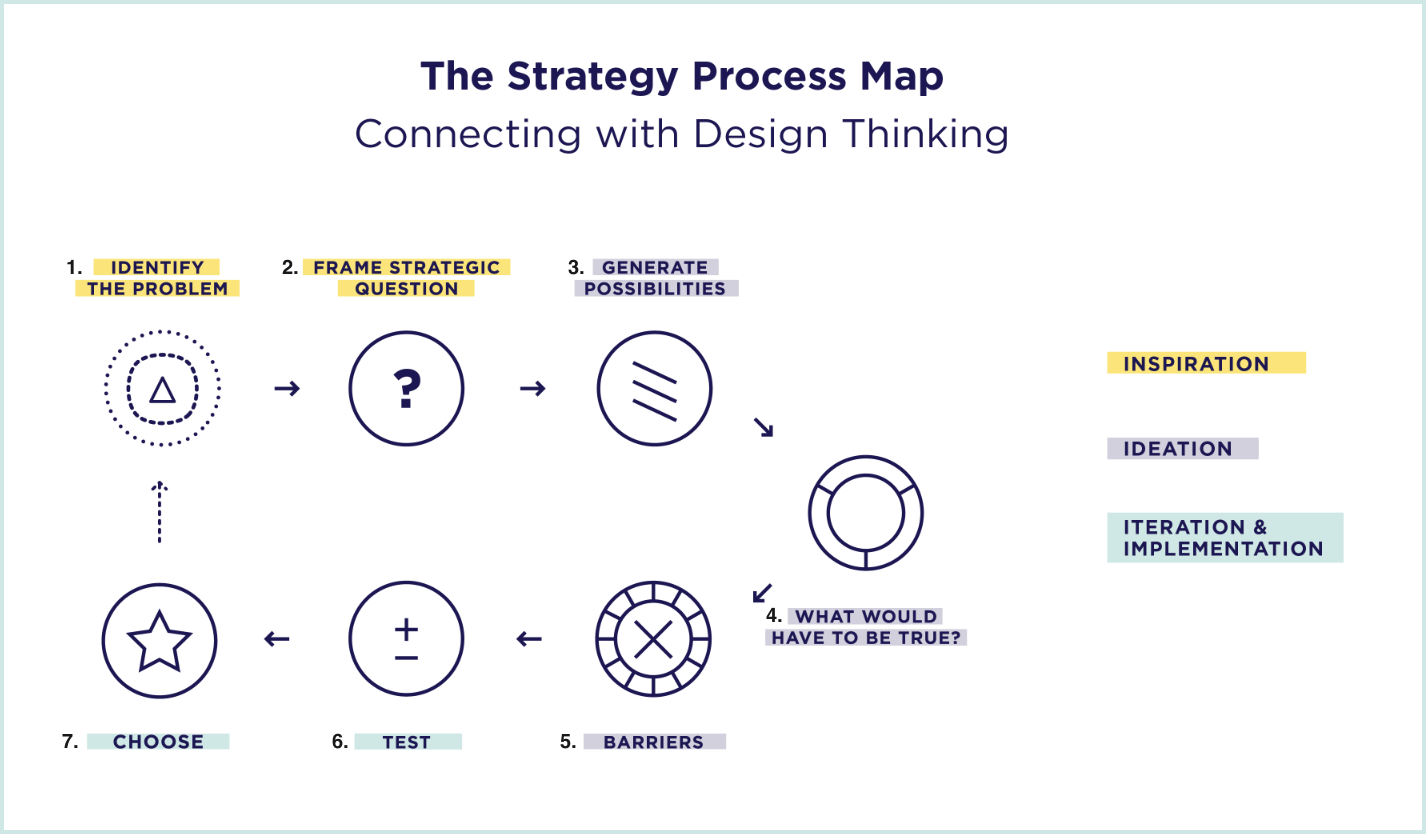
Step 1: Identify the Strategic Problem
Articulate the biggest problem with the present strategy. What isn’t working? What’s stopping the business from achieving their aspirations?
Step 2: Frame a Strategic Question
Turn the problem into a strategic question to set the stage for generating possibilities. “How might we…”
Step 3: Generate Strategic Possibilities
Brainstorm strategic possibilities that answer the question in a compelling way.
Step 4: Ask “What Would Have to Be True?”
Define the conditions under which each possibility could be a winning strategy.
Step 5: Identify Barriers
Per each condition, select those that feel the most worrisome or uncertain. These will require testing before evaluating the strength of the strategy.
Step 6: Test to Learn
Conduct research, design tests, and build iterative prototypes to learn to what extent barriers are true or not.
Step 7: Make a choice
Bring together test results, and use that information to choose a strategic possibility to pursue.
The second framework is the Strategy Choice Cascade. This is a 5-part framework that surfaces essential components of any strategic possibility. This guides exploration and a way to visualize/share the strategy with others.
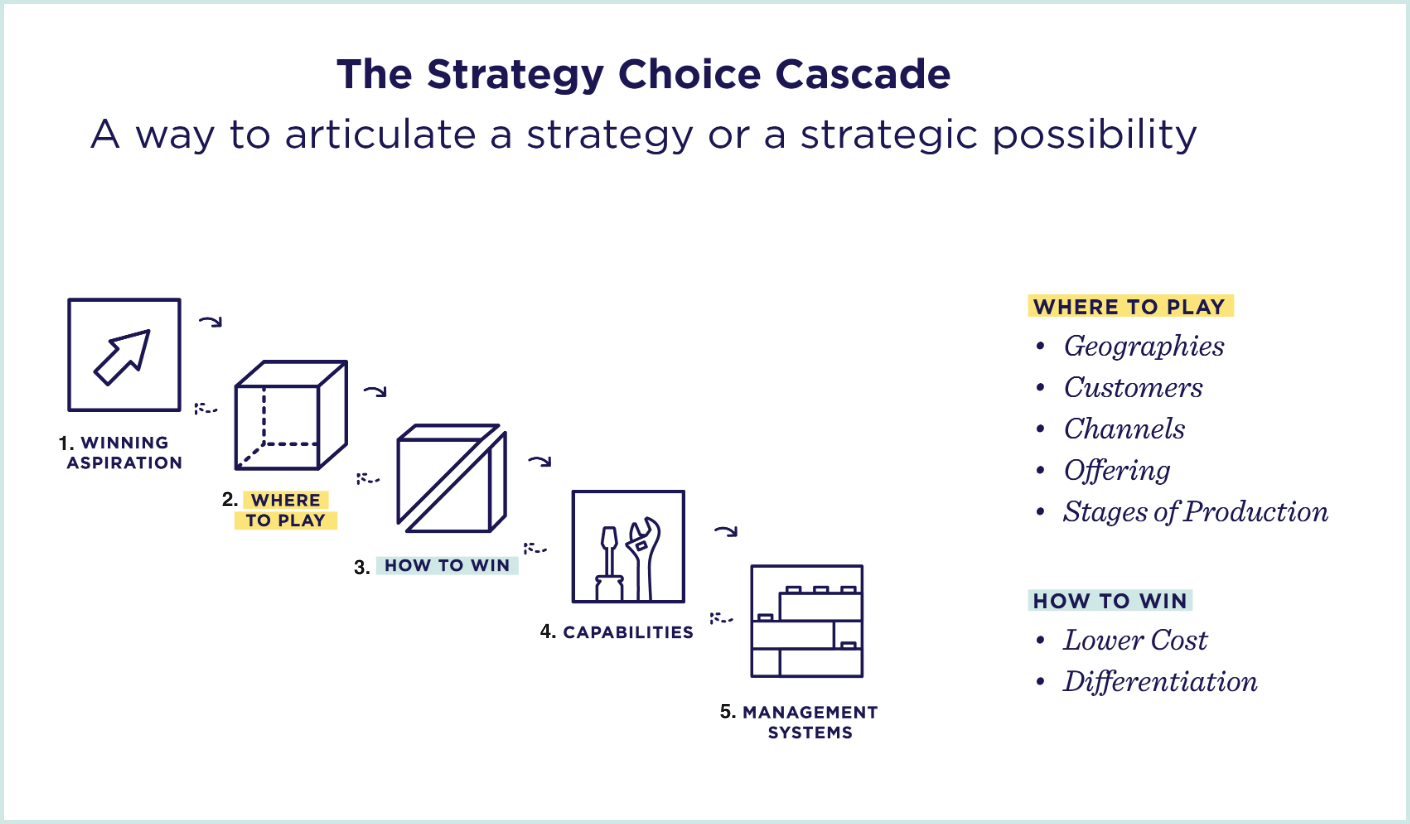
Part 1: Winning Aspiration
The definition of what winning looks like for the organization. This is an essential question, as the answer defines what the company is really trying to accomplish.
Part 2: Where to Play
Where the company chooses to compete. This includes five dimensions:
Geography: What parts of the region, country or world will you play in?
Customer: Who are the customers at the heart of your strategy?
Channel: How will you reach your customers - directly, or through dealers, wholesalers, or retailers?
Offer: Which products and services will be the core of what you sell?
Stages of Production: What will you do yourself and what will you leave to suppliers, channels and partners?
Part 3: How to Win
What is the company’s competitive advantage to win with customers sustainably? This is done in one of two ways:
Lower Cost: you offer a product or service to customers that they see as equal in value to other offers, but which costs you less to produce.
Differentiation: you offer a product or service that is distinctive in a way that customers value (that is, that they will pay more for).
Part 4: Capabilities
Activities that you will need to build your competitive advantage. If you don’t have or develop a distinctive set of capabilities, you won’t have a distinctive way to win. “Capabilities” are things you do, like customer service, innovation and manufacturing.
Part 5: Management Systems
The infrastructure, systems, processes, and metrics that support and measure your strategy over time. “Management Systems” can include things like IT platforms, organizational structures, train- ing programs and key measures.
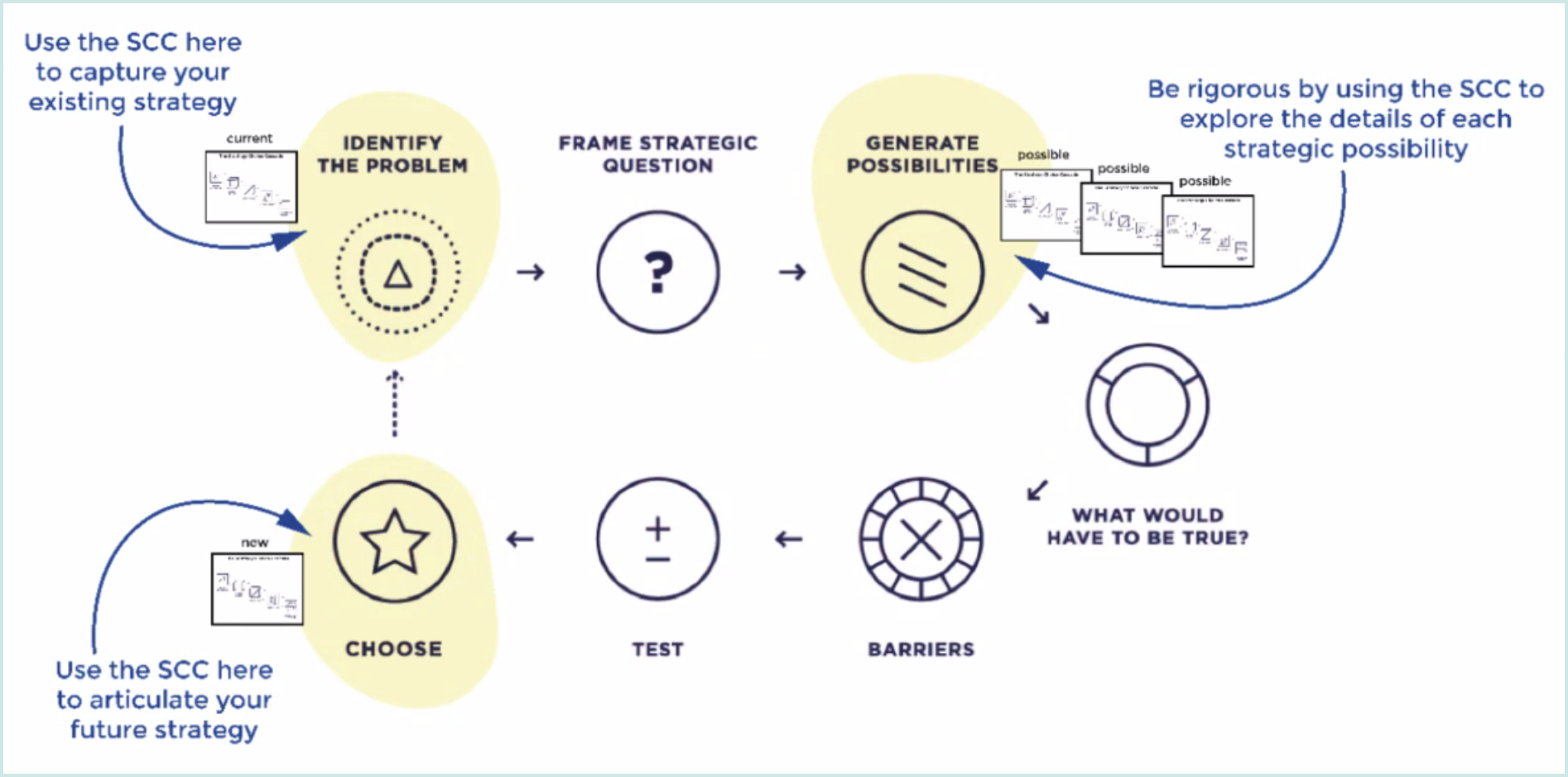
The Process Map is the overarching framework and contains instances where the Choice Cascade is used to describe strategic possibilities.
Going Through the Design Process
Steps 1 and 2: Identify the Strategic Problem + Frame a Strategic Question
What are possible problems that would increase customer churn and decrease growth?
Customers have moved out of the targeted neighborhoods.
Customers are tired of the products and have gone to competitors.
Customers’ spending habits have changed and they have left the market.
Our customers have gone to competitors.
We mapped out JtD’s current strategy using the Strategy Choice Cascade. This is a summary of what the company is choosing to do and not to do in their day-to-day business activities.
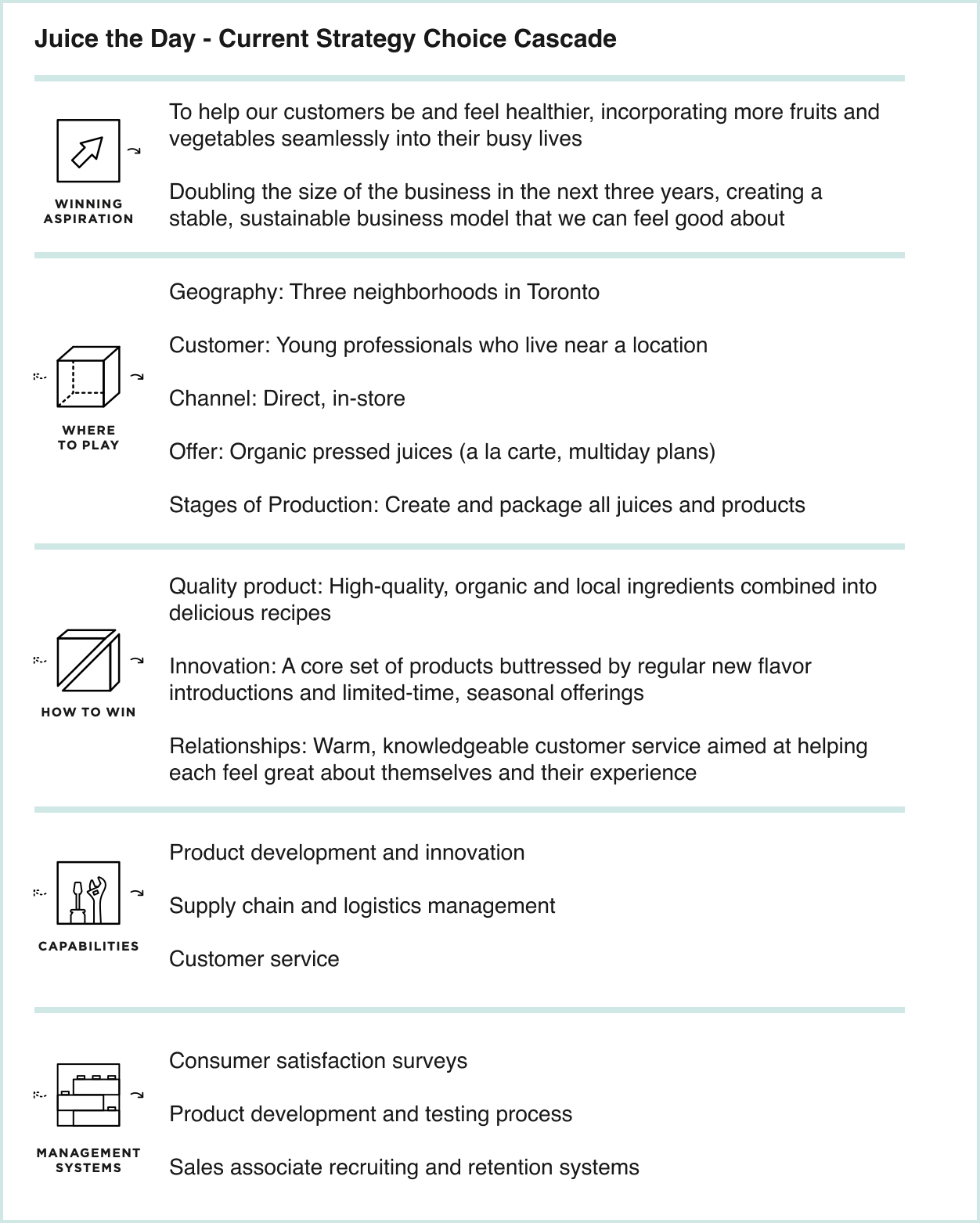
From there, we were able to reframe our background material into a problem needing to be solved:
How might we grow our juice bar business sustainably– increasing our impact in the world and creating a more sustainable advantage in a crowded market?
The team wanted to hold their core value of sustainability in the face of rising competition and slow growth of its core retail business.
It was important for this question to be open enough to inspire possibilities, but focused enough to tackle the current issue. It needed to include who we’re designing for, and not a solution in the question.
Step 3: Generate Strategic Possibilities
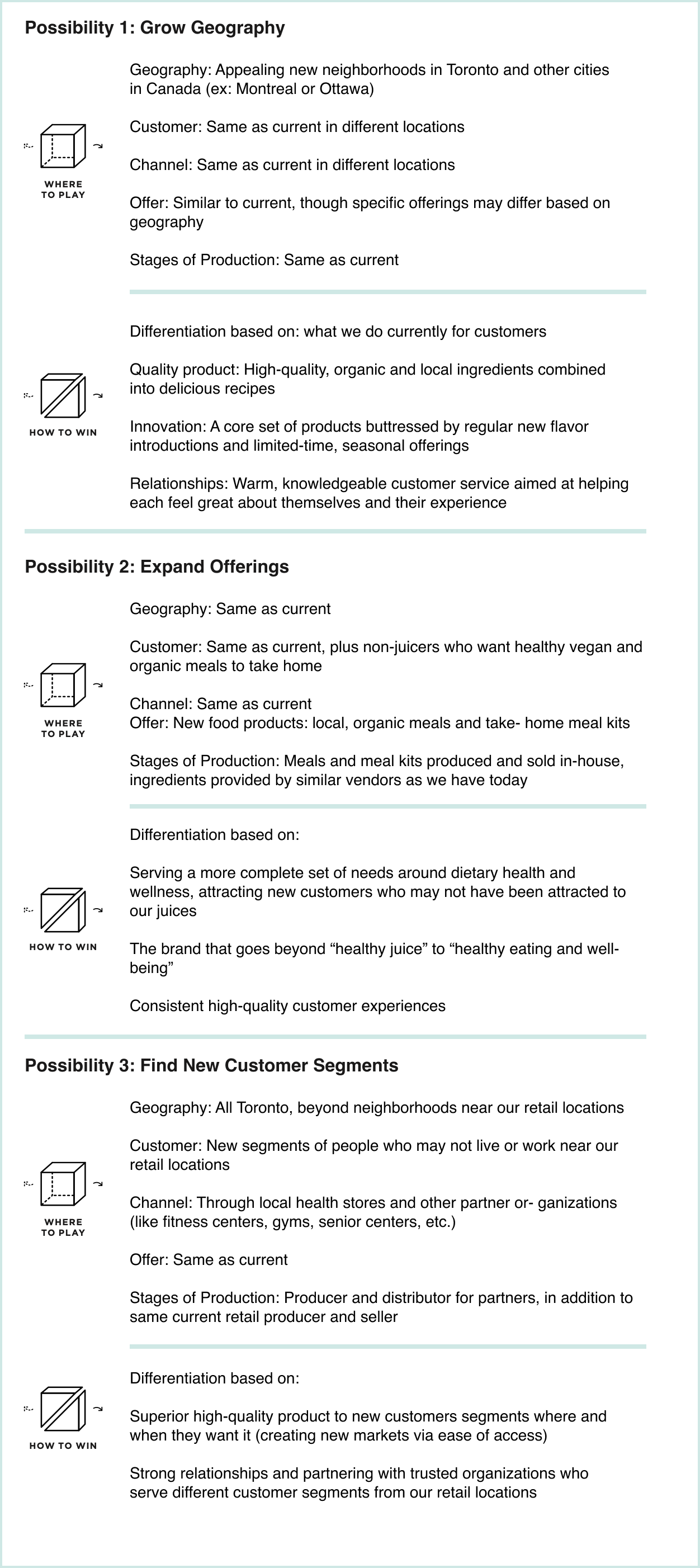
We used the Strategy Choice Cascade as a reference, adjusting the “Where to Play” and “How to Win” parameters to develop 4 possibilities. The team also considered situations where time and resources might be expanded or limited:
POSSIBILITY 1: OPEN MORE LOCATIONS
Do what we do today, but in more locations; expanding to new neighborhoods that are most similar to our current locations, possibly in Toronto, possibly in nearby cities.
POSSIBILITY 2: EXPAND WHAT WE OFFER
Create new offerings to sell in our current locations.Introduce new organic vegan and vegetarian meals and meal kits.
POSSIBILITY 3: FIND NEW CUSTOMER SEGMENTS
Develop partnerships to reach new customers. Find new customer segments for our existing products: Target partner- ships with sports clubs, fitness centers, senior centers, etc., and sell in local health stores.
POSSIBILITY 4: DO NOTHING
Continue “as is”: no changes to the existing products and locations for the juice company.
For strategic possibilities 1-3, we needed to state how the Choice Cascade will be adjusted:
Step 4: Ask “What Would Have to Be True?”
This step identifies ideal conditions that would make each possibility a winning idea. It was helpful for us to put the conditions into 3 groups:
Customers: the users, their values and behavior, their channels, the size of a demographic
Company: the business, their capacities, the teams, tech, resources
Competition: how would competing companies react? Would new competitors emerge?
POSSIBILITY 1: OPEN MORE LOCATIONS
Customers
There are enough new neighborhoods (that are not already well-served) for JtD to meet growth target.
Customers in new markets are similar enough to existing customers and will be happy with JtD’s current offering.
Customers will continue to want organic juice offerings at a premium price in the future.
Company
JtD can find quality locations at a reasonable cost.
JtD can maintain focus and quality across additional locations.
JtD can secure financing to fund the new affordable locations
JtD can attract customers to new locations at a rate and cost similar to existing ones
Competition
Big competitors will spread their resources across more markets, allowing JtD to get the benefits of clear focus on our neighborhoods.
Small local competitors will not target the same neighborhoods in the same ways.
POSSIBILITY 2: EXPAND OFFERINGS
Customer
Our existing customers will value the addition of these new offers enough to increase the frequency of visits or basket size.
New customers will be attracted by these offers, within our existing markets.
These new offers, which will likely have lower margin than our juices, will not cannibalize our juice sales.
Company
We have the capabilities to source, make, and sustainably deliver these new products at a high level of quality.
The margin on the new offers will be good enough to justify the investment.
We can do this at a cost level that will let us price the new offers competitively with other premium offers.
We can communicate this new offer effectively to new and existing customers.
We have the room and infrastructure to make and display these products without having to do significant store retrofits.
Competition
Local restaurants will not aggressively increase marketing, partner with other juice providers, or decrease prices to prevent us from getting a toehold in this market.
Other juice companies will not copy this strategy as well or better than us, in our neighborhoods.
POSSIBILITY 3: FIND NEW CUSTOMER SEGMENTS
Customers
Customers in these new segments will buy from us in high-enough numbers to make the investment worthwhile.
Customers will value the ease of access through these new channels.
These segments are big and attractive enough for us to target sustainably.
Partners will be interested in a relationship with us (and will not charge unsustainably high fees for access).
There are enough quality partners for us to reach these customers without diminishing our brand.
Company
We can negotiate effectively with partners to build a business model that works.
We can win with these segments without having to build new product offerings.
We can target and serve these new segments cost- effectively.
We can earn our price premium even if these customers don’t come to the store/experience our service in person.
Competitors
Competitors will not follow us into this space within the next year.
Step 5: Identifying Barriers
Barriers are a subset of “what would have to be true” conditions that the company is most worried about. Which conditions aren’t likely to be true? Which seems least likely to be true? Which ones do we know the least about? What isn’t true today, but might be true in the future? To what extent do we believe we could make it true? If something can be made true, it’s not a barrier.
POSSIBILITY 1: OPEN MORE LOCATIONS
Customers
There are enough new neighborhoods (that are not already well-served) for JtD to meet growth target.
Company
JtD can find quality locations at a reasonable cost.
JtD can attract customers to new locations at a rate and cost similar to existing ones
Competition
Big competitors will spread their resources across more markets, allowing JtD to get the benefits of clear focus on our neighborhoods.
POSSIBILITY 2: EXPAND OFFERINGS
Customer
Our existing customers will value the addition of these new offers enough to increase the frequency of visits or basket size.
New customers will be attracted by these offers, within our existing markets.
Company
We have the capabilities to source, make, and sustainably deliver these new products at a high level of quality.
The margin on the new offers will be good enough to justify the investment.
Competition
Local restaurants will not aggressively increase marketing, partner with other juice providers, or decrease prices to prevent us from getting a toehold in this market.
POSSIBILITY 3: FIND NEW CUSTOMER SEGMENTS
Customers
Customers in these new segments will buy from us in high-enough numbers to make the investment worthwhile.
Customers will value the ease of access through these new channels.
These segments are big and attractive enough for us to target sustainably.
Company
We can target and serve these new segments cost-effectively.
We can earn our price premium even if these customers don’t come to the store/experience our service in person.
Step 6: Test to Learn
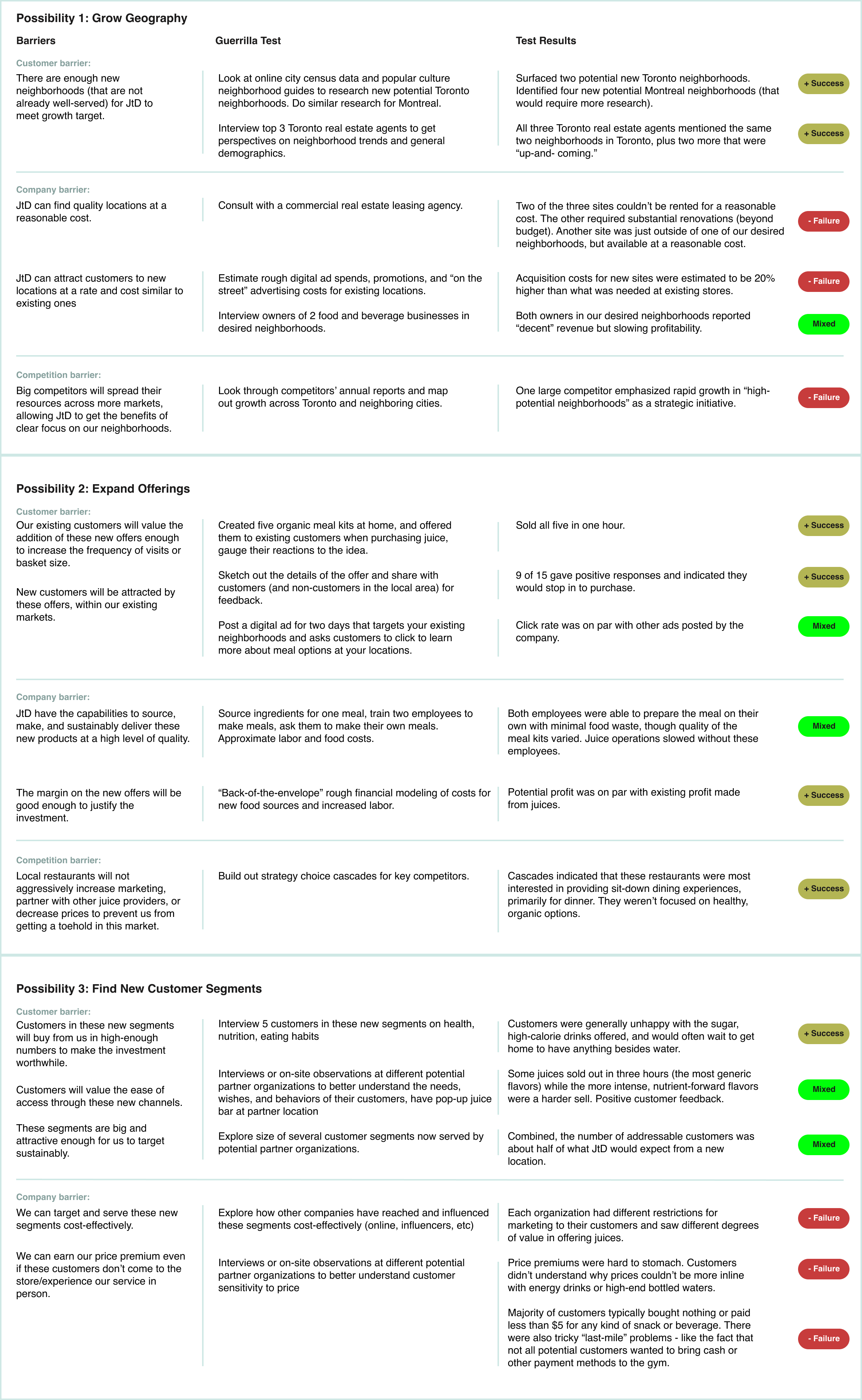
This step involves testing each barrier to gather evidence about them and ultimately improve our odds of designing a winning strategy. Depending on the time and resources at hand, these tests can be categorized as guerrilla tests, indicative tests, and high-fidelity tests.
Guerrilla tests are fast, scrappy, and low cost. Indicative tests require a bit more time and money, and are used when a higher standard of proof is needed. High fidelity tests require a team with considerable time and resources to conduct.
For each barrier, we developed a couple of guerrilla tests and identified criteria for success and failure. Below is a summary of the tests per barrier and the mock-results from each test.
Step 6: Make a Choice
Regarding Possibility 1: Open More Locations, tests indicated that it wasn’t possible to find good locations in attractive neighborhoods that would permit profitability, nor would they be able to avoid competition there.
Regarding Possibility 3: Find New Customer Segments, tests showed that customers wouldn’t pay the premium price, especially without quality service or in-store experience. Also, they wouldn’t be able to reach enough new customers to make this strategy sustainable. Additionally, it seemed that JtD would face restrictions when marketing and selling to each partner organization’s customers.
Testing showed that Possibility 2: Expand Offerings was the most promising strategy. We demonstrated that there was an untapped demand for meals and meal kits from both existing customers and new customers. JtD was able to create meals and meal-kits in store and achieve good margins. More research was needed to estimate precise costs and revenue to help maximize returns and not disrupt the core juice business.
After summarizing the data we gathered through testing, we aligned behind Possibility 2: Expand Offerings.
Conclusion
Leveraging the Strategy Process Map and the Strategy Choice Cascade, we were able to audit Juice the Day’s current strategy and problems. We reframed their problem into a strategic question and generated 3 possibilities to solve for that question. We explored each possibility and identified conditions that would have to be true to make that possibility work. From there, we honed in on uncertain barriers and developed tests to validate them. After running these tests, we analyzed the data and selected a winning strategy to move forward.